

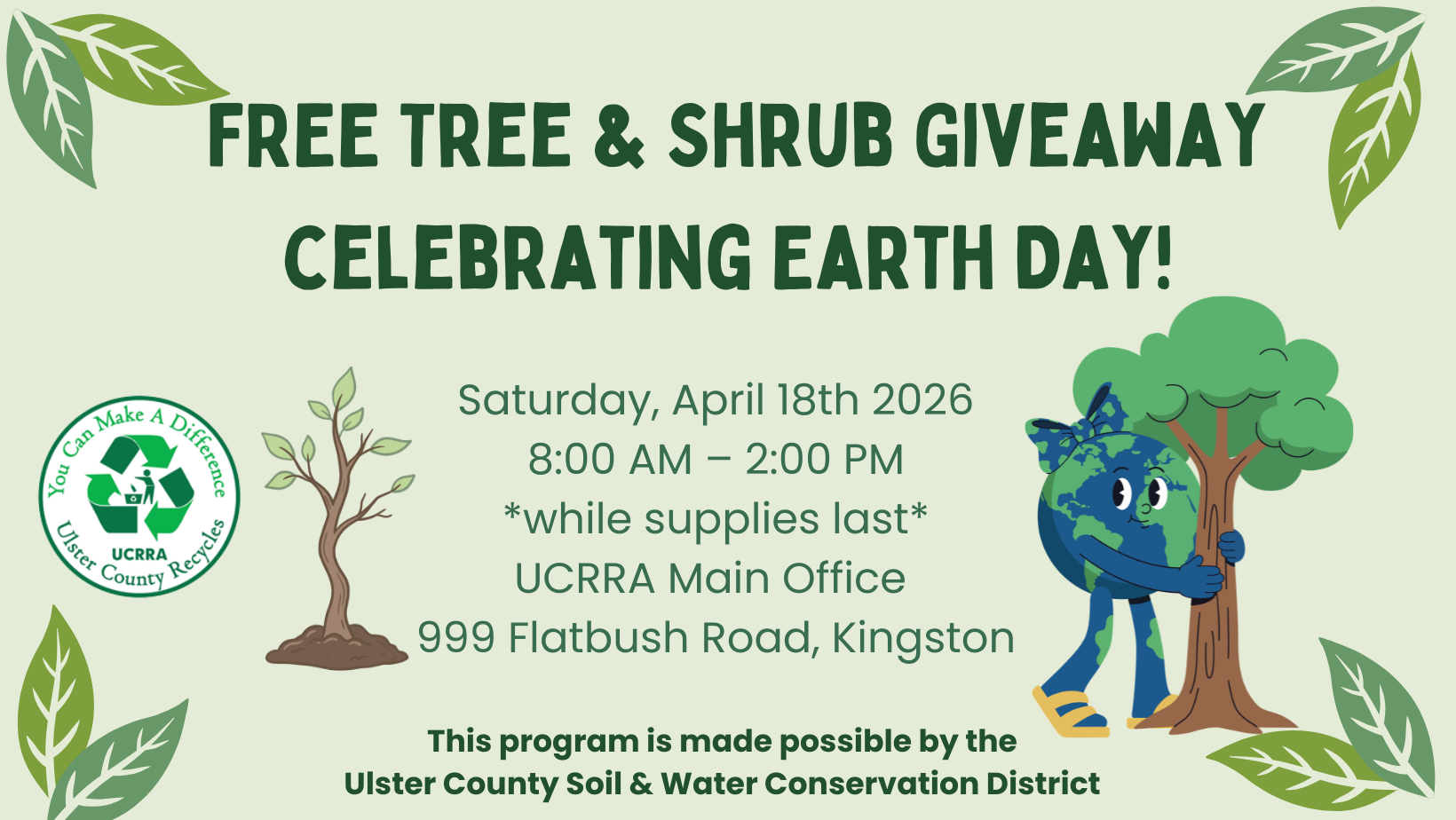
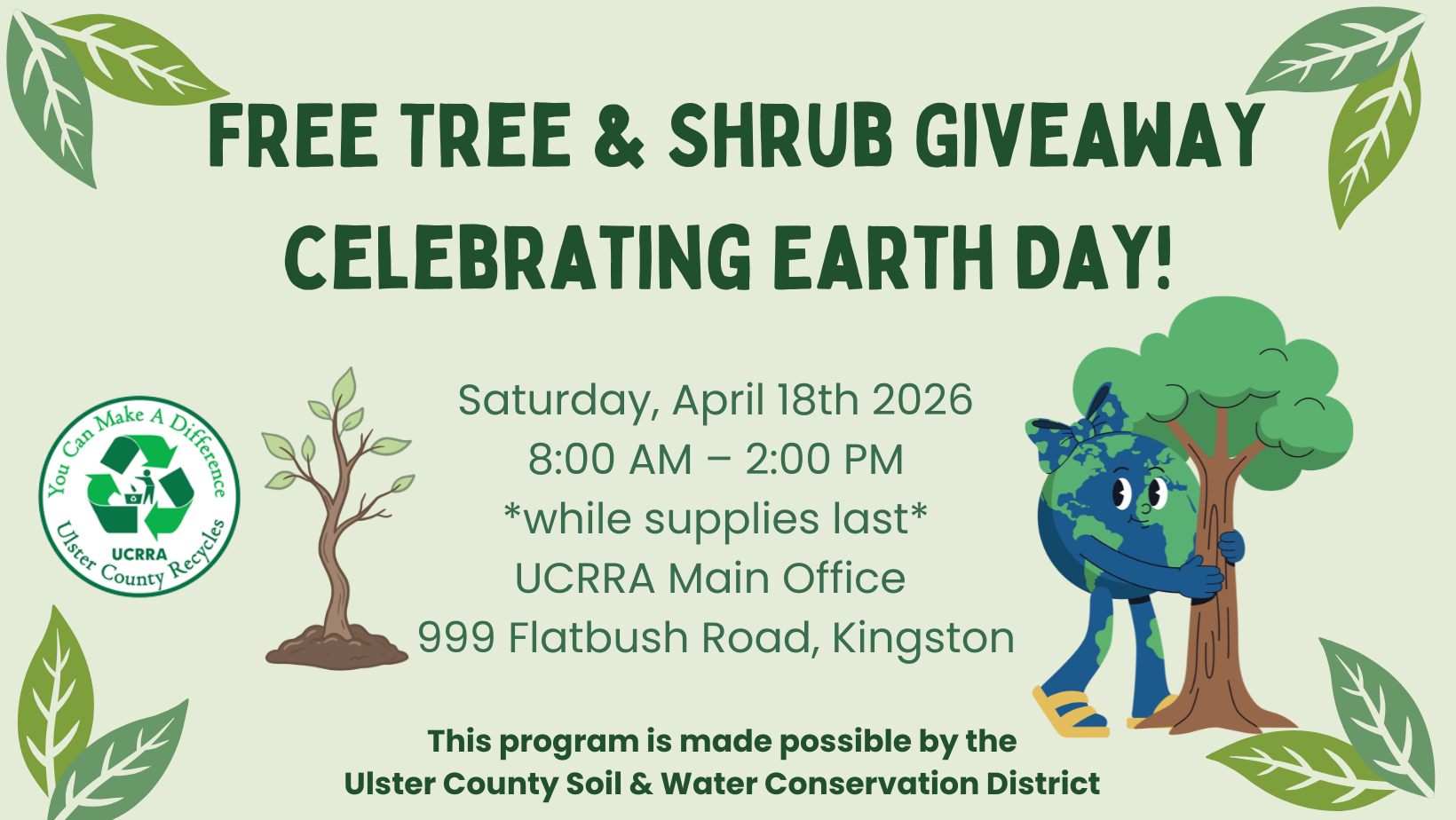
On Saturday, April 18th, residents who drop off electronics for recycling and/or residents that pick up an order of bagged compost will receive a free tree sapling/shrub as our gift to you to celebrate Earth Day!
Please note: tree saplings/shrubs will be distributed while supplies last, with limited inventory available, and several different options to choose from!
This program is made possible by the Ulster County Soil & Water Conservation District.
While we cannot guarantee which tree/shrub species will be available; the giveaway may include the following species:
Arborvitae, Arrowwood, White Flowering Dogwood, Red Osier Dogwood, Eastern Redbud, Ninebark, Pin Oak, White Oak, and Sugar Maple.
*All species are native varieties: saplings may range in size from 6 inches to 2 feet.
Accessibility: This is an outdoor event resembling a “drive-through” experience. On arrival at the Main Office parking area, an attendant will be directing cars through the parking lot via the established electronics recycling traffic pattern “loop.” Ask an attendant about the tree distribution station. The area is a gravel parking lot providing uneven, loosely compacted rocks. A flat, paved parking lot area is located about 50 feet from the electronics recycling loop. Residents may park in designated parking areas to collect a tree/shrub, given staff instructions or the traffic pattern of the loop.
Get to Know the Trees & Shrubs
Arborvitae:
18″ – 24″ bareroot seedling.
Arborvitae functions exceptionally well as a year-round privacy screen or wind break. It stands apart from other native conifers because of its thick scale-like foliage. If cared for arborvitae may be exceptionally long lived, it is one of the northeast’s oldest living trees! Make sure to keep this species well-watered during its first few years, even occasionally throughout the winter since it does not go dormant like deciduous trees.
dogwood, red osier:
18″ – 24″ bareroot seedling.
Red osier dogwood is a low-growing dogwood shrub, typically growing between 3-9’ tall. Bright red stems make up for this species more subdued flowers compared to other flowering dogwoods and provide a great color contrast in the winter. This species grows well in moist soils and makes an excellent streamside planting. It is often used to combat soil erosion.\
dogwood, white flowering:
12″ – 18″ bareroot seedling.
White flowering dogwood is loved for its showy flower petal bracts which emerge bright white in the spring. An understory tree, it grows only 15-30’ tall making it manageable in garden settings. It prefers moist soils and partial shade. Benefits from mulch over root zone.
redbud:
12″ – 18″ bareroot seedling.
The vibrant pink flowers of the redbud tree are a welcomed sight of the springtime landscape. Widely planted in yards throughout the Northeast, this small tree has dark green heart shaped leaves and a unique branching structure. Its tolerance of a wide variety of planting conditions make it versatile and a great option for novice gardeners. Plant it in your yard and watch it grow!
ninebark:
12″ – 18″ bareroot seedling.
Common Ninebark is a flowering shrub with peeling bark that grows 8-10 feet wide. The dense, spreading form of this plant serves as an effective windbreak for local wildlife. It prefers full to partial sun and is tolerant of medium-wet to medium-dry soils.
Pin Oak:
12″ – 18″ bareroot seedling.
Pin Oaks are relatively fast-growing type of red oak which will generally reach 50-70 feet in height. They are good shade trees with a spread of about 40-60 feet. These trees prefer medium to wet soils and full sun. Not recommended in areas with high soil pH.
Sugar Maple:
12″ – 24″ bareroot seedling.
Perhaps the most iconic tree of the Northeast, mature sugar maples are cherished in parks and rural landscapes. Slow growing but strong and stately if cared for and pruned appropriately, planting sugar maples is truly a gift for future generations to enjoy. Sugar maples prefer drier sites than red and silver maples and do best in well drained soils. Apply mulch around the root zone if planted in a lawn for nourishment and to prevent competition from turf grass. Look for brilliant chartreuse buds during mid-spring which distinguish sugar maples from red and silver maples which produce red colored buds.
White Oak:
12″ – 18″ bareroot seedling.
White Oaks make excellent shade trees with a mature spread of up to 80 feet, reaching heights of 50 to over 100 feet. They provide wonderful Fall color as well as habitat and food for wildlife. Full sun to partial shade works best for these trees.
Instructions for Planting Trees & Shrubs
Source: United States Composting Council (USCC) Consumer Compost Use Program
Establishment: Excavate a planting hole slightly shallower and 2 to 3 times the width of the root ball or container. Set the root ball on firm soil so that the top of the root ball sits slightly higher than the final grade. Uniformly blend compost with the excavated soil at one (1) part by volume compost to 2-3 parts by volume soil. Compost with higher amounts of salts and nutrients should be used at lower rates (e.g. 1:3 or 1:4 parts compost to soil). Backfill and firm the soil blend around the root ball within the planting hole. Always water thoroughly after planting. It should be noted that whenever possible, trees and shrubs should be planted in a mass planting bed, where multiple plants are established in a larger amended bed. This technique allows for greater planting success. Lower compost application rates should be used for salt sensitive crops (e.g., conifers), or where composts possessing higher salt and nutrient levels are used, while higher application rates may be used for plants that require greater amounts of fertility.
Maintenance: Apply a coarser compost mulch (1” – 2” screened) over the garden bed to conserve moisture, for weed suppression
and/or for aesthetic purposes. Note: The nutrients contained in compost should be considered when applying fertilization. They
will typically offset plant nutrient requirements, thereby potentially reducing fertilizer application rates.
Compost has many horticultural benefits and uses.
- Compost adds a slow release of nutrients
- Compost adds beneficial soil organisms, reducing the need to use chemical pesticides
- Compost aids in suppressing plant disease pathogens, reducing the need to use chemical fertilizers
- Compost increases moisture retention, so you don’t need to add water to garden beds as frequently
- Compost helps improve soil structure, porosity, and density
- Compost makes any soil easier to work and cultivate
Disclaimer: The USCC makes no warranties regarding UCRRA’s Compost product or its contents, quality, or suitability for any particular use. Please refer to the individual producer’s product label for specific use instructions.
Learn more by viewing the UCRRA Rack Card Tree & Shrub
Learn more about the Agency’s Certified Compost by viewing the UCRRA Brochure STA Program
We’re Celebrating Earth Day!
The first Earth Day was celebrated in 1970, when a U.S. Senator organized a national demonstration about environmental issues and environmental conservation. By the end of the year, the Environmental Protection Agency was created. And by 1990, Earth Day was celebrated internationally by 140 countries.
According to National Geographic, roughly 15 billion trees are cut down each year around the globe. Trees absorb carbon dioxide and release oxygen, essential for life on Earth! Trees also provide shelter and food for wildlife and help cool the climate. By taking part in activities like planting trees, and using compost, we can all do our part to create a healthier, more sustainable planet.
Recycled Paper Facts:
By weight, more paper is recovered for recycling in America than all other materials combined (except for steel). In 1988, recovered paper made up about 25 percent of the raw materials used at US paper mills. That figure rose to 36.3 percent in 1999 and has remained around 36-37 percent through 2007. More than 3/4 of America’s paper mills use recovered fiber to make some or all of their products. Approximately 140 mills use recovered paper exclusively. As a result, virtually all types of paper products contain some recycled fiber. Since 1994, significantly more paper has been recovered in America than landfilled. Source: Environmental Protection Agency.